Wednesday, September 2, 2026
BUSINESS• REGIONAL REPORT

Upper Manhattan Businesses Enter Final Weeks to Contract Authorized Private Haulers Ahead of Commercial Waste Zone Activation

Department of Sanitation warns non-compliant storefronts and commercial landlords will face automatic carter assignment at maximum legal caps as Local Law 199 takes effect across Harlem, Washington Heights, and Inwood.
By NY District News Staff•Harlem & Washington Heights, Manhattan
November 15, 2026|7 min read
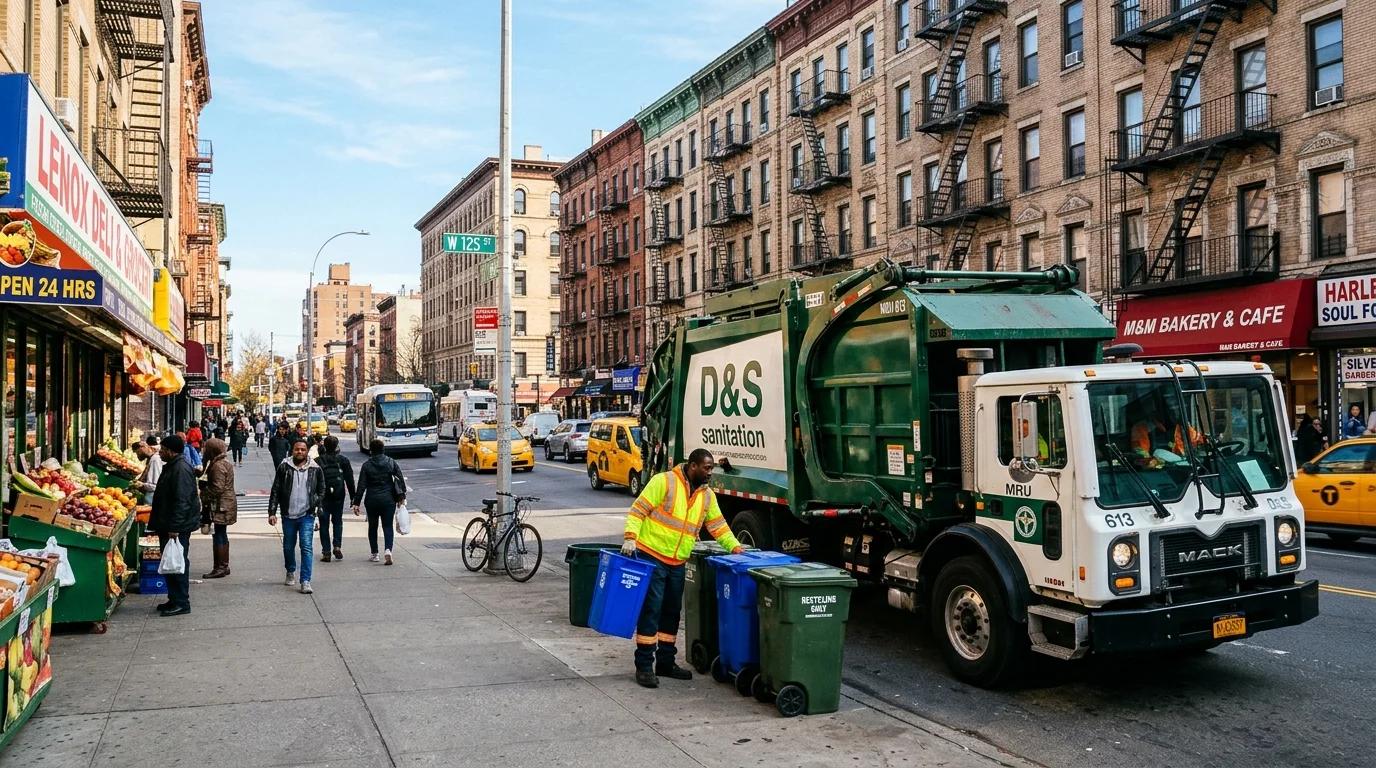
A modern commercial waste collection truck operating along an Upper Manhattan commercial corridor lined with neighborhood storefronts and small businesses.

A commercial waste collection vehicle operating along a commercial avenue in Upper Manhattan. Under Local Law 199, businesses in Upper Manhattan must transition from an unregulated open-market carting system to designated, zone-specific private haulers ahead of the city's mandatory December 1 activation deadline.

NY DISTRICT NEWS

KEY FINDINGS

  • •Upper Manhattan's Commercial Waste Zone officially takes effect on December 1, 2026, requiring thousands of commercial establishments across Harlem, Washington Heights, and Inwood to secure service contracts with authorized private haulers.
  • •Businesses failing to sign an agreement by the transition cutoff will be automatically assigned to a designated zone carter at the city's maximum legal rate ceiling, forfeiting competitive pricing.
  • •Local Law 199 replaces the chaotic open-market carting system with three vetted, zone-specific standard carters, eliminating overlapping truck routes and reducing local diesel emissions.
  • •The transition follows successful zone launches in Queens Central, Lower Manhattan, and Midtown South, advancing the city's multi-year commercial waste overhaul.
WHY THIS MATTERS

For decades, unregulated commercial carting sent dozens of competing private garbage trucks down the same residential and commercial corridors every night, creating severe noise pollution, elevated emissions, and dangerous pedestrian conditions; the Upper Manhattan zone rollout tests whether city-mandated route consolidation can deliver environmental justice to historic northern Manhattan neighborhoods without imposing undue financial burdens on immigrant-owned small businesses.

MANHATTAN — Across Harlem, Washington Heights, and Inwood, thousands of restaurant owners, bodegas, grocery operators, and retail merchants are entering the final sprint of a historic regulatory transition. Starting December 1, New York City will officially activate the Upper Manhattan Commercial Waste Zone, ending decades of open-market private trash hauling across Manhattan Community Districts 9, 10, 11, and 12 and replacing it with a tightly regulated municipal franchise system.

The impending activation marks the latest and one of the largest phases in the rollout of Local Law 199 of 2019, landmark legislation designed to overhaul New York City's private carting industry. For more than half a century, commercial trash collection in New York operated under an unregulated free-market model: any licensed carter could service any storefront anywhere in the five boroughs. The result was nightly logistical chaos, with dozens of overlapping diesel trucks crisscrossing the same neighborhood corridors each evening, generating severe noise pollution, localized diesel particulate emissions, and dangerous pedestrian traffic.
Under the Commercial Waste Zones framework administered by the New York City Department of Sanitation (DSNY) in coordination with the Business Integrity Commission (BIC), the city has carved the five boroughs into 20 designated commercial zones. Within each zone, DSNY conducted a competitive procurement process, selecting up to three authorized standard carters alongside designated citywide containerized waste specialists. For Upper Manhattan, businesses are legally restricted to selecting only from the city-selected carters assigned to their district.
With less than three weeks remaining before the December 1 go-live deadline, DSNY has stepped up merchant outreach and issued firm compliance advisories. Under municipal rules, every commercial establishment that generates refuse or recycling is required to enter into a written customer agreement with one of the authorized zone carters. Establishments that fail to execute an agreement by the transition cutoff will not see their trash pile up—instead, the city will systematically auto-assign them to one of the designated haulers. Crucially, auto-assigned merchants are billed at the maximum statutory rate ceiling permitted by city regulations, stripping them of competitive discounts or negotiated terms available during the active transition window.
For small business advocates and merchant associations along 125th Street, Broadway, and Saint Nicholas Avenue, the operational shift represents both a relief and an administrative scramble. Local merchant groups have praised the anticipated reduction in nocturnal truck traffic and the elimination of predatory pricing practices that historically plagued small independent businesses. However, smaller immigrant-owned businesses and specialty food purveyors have voiced anxiety over understanding multi-stream recycling mandates and reviewing lengthy commercial contracts during an already challenging economic climate.
To assist local business owners, DSNY and neighborhood merchant coalitions have hosted multilingual informational workshops across Harlem and Washington Heights, offering guidance on waste audits, containerization requirements, and contract evaluation. The city has emphasized that standard carters must offer comprehensive recycling and organic waste collection, aligning commercial operations with the city's broader zero-waste sustainability targets.
Environmental justice organizations have hailed the Upper Manhattan launch as a critical step toward rectifying decades of disproportionate pollution burdens. Northern Manhattan communities have historically suffered from elevated childhood asthma rates and environmental degradation exacerbated by heavy commercial freight and truck congestion. By consolidating hauling routes into discrete geographic zones, DSNY models project that the citywide program will eliminate millions of private carting truck miles every year, significantly reducing greenhouse gas emissions and vehicular collisions while enforcing strict labor and safety standards across hauling crews.
As the calendar turns toward December, City Hall is closely watching the Upper Manhattan activation as a benchmark for subsequent Manhattan zones scheduled to launch throughout 2027. For thousands of northern Manhattan merchants, the coming days demand immediate attention to ensure their contracts are locked in before the deadline strikes and the city takes waste management decisions into its own hands.
NY

By NY District News Staff

NY District News reporters cover local government, business, consumer issues, tax fairness, and public accountability across New York.

Share Record:
XFB

Know More About This Story?

If you have documents, records, correspondence, photographs or first-hand information related to this investigation, NY District News wants to hear from you.
CONTINUE READING: MORE FROM NY DISTRICT NEWS

Circular Loop Navigation
THE DISTRICT BRIEF

Serious reporting. Right in your inbox.

Investigations, document dumps, and local accountability stories. No visual noise. Just New York journalism that matters.

Weekly accountability reports. Never shared. Unsubscribe anytime.