Wednesday, September 2, 2026
COMMUNITY• REGIONAL REPORT

Mayor Mamdani and NYPD Commissioner Tisch Disband Strategic Response Group in Sweeping Protest Policing Overhaul

City Hall replaces the controversial rapid-response unit with a civilian-led Community Dialogue and De-escalation Division, a 30-officer NYPD liaison team, and strict bans on kettling, tear gas, and pepper spray at demonstrations.
By NY District News Staff•New York, New York
November 17, 2026|8 min read
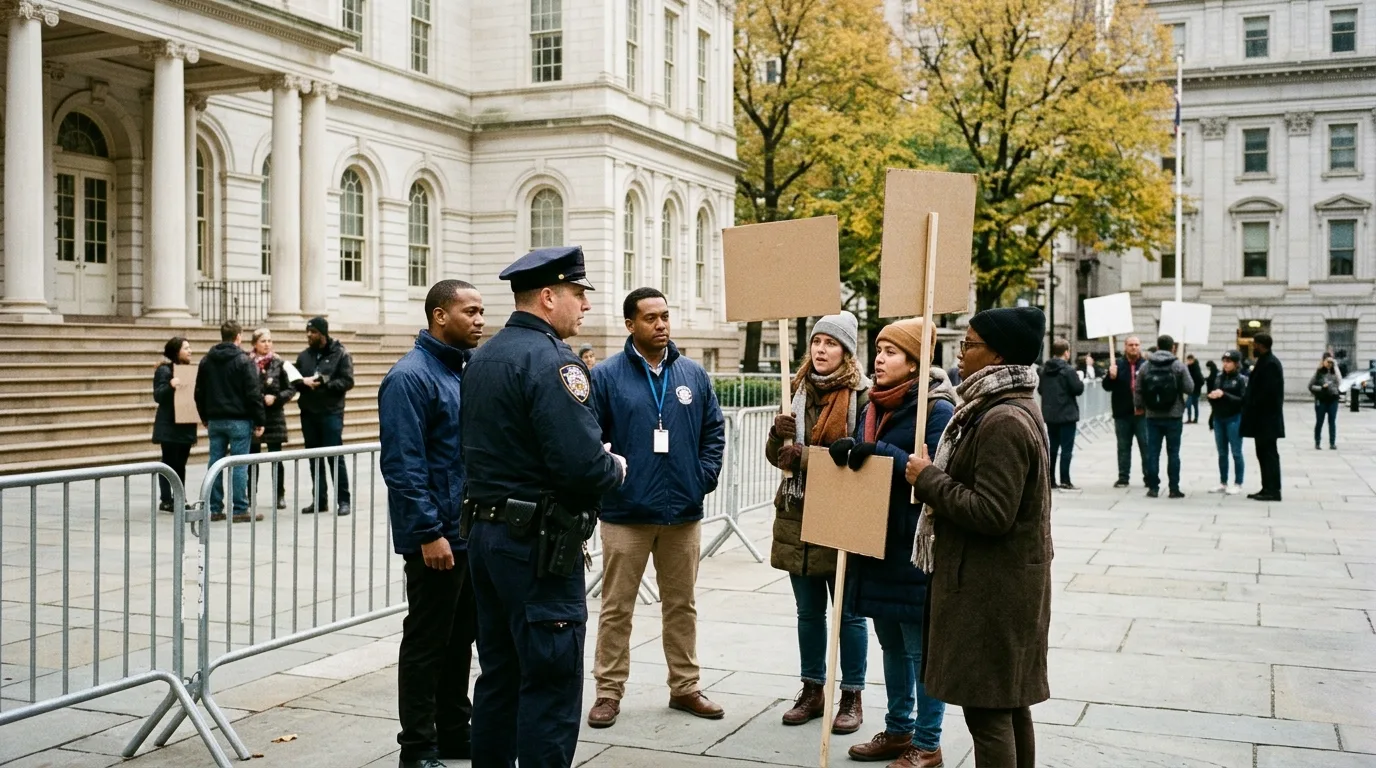
A uniformed NYPD liaison officer and civilian municipal de-escalation coordinators speaking calmly with peaceful demonstrators near metal pedestrian barricades outside New York City Hall in Lower Manhattan.

Outside New York City Hall in Lower Manhattan, civilian municipal coordinators and NYPD liaison personnel engage with demonstrators near pedestrian barricades. Under the structural overhaul announced by Mayor Zohran Mamdani and NYPD Commissioner Jessica Tisch, the Strategic Response Group is disbanded and protest dialogue shifts to civilian-led de-escalation.

NY DISTRICT NEWS

KEY FINDINGS

  • •Mayor Zohran Mamdani and NYPD Commissioner Jessica Tisch officially disbanded the Strategic Response Group (SRG) on November 16, 2026, separating counterterrorism operations from protest response.
  • •A new civilian-led Community Dialogue and De-escalation Division (CDDD) inside the Mayor's Office of Community Safety will mediate at demonstrations without weapons or arrest powers.
  • •Inside the NYPD, a 30-officer First Amendment Support Team (FAST) in the Community Affairs Bureau and a new Patrol Support Division (PSD) replace the SRG's crowd-management role.
  • •Binding tactical rules prohibit kettling, tear gas, long guns, and general crowd-control pepper spray during First Amendment assemblies, while transferring counterterrorism duties to the Intelligence and Counterterrorism Bureau.
WHY THIS MATTERS

For more than a decade, deploying a heavily armed counterterrorism unit to manage routine political marches strained police-community relations and generated costly civil rights litigation; dismantling the SRG in favor of civilian de-escalation and strict tactical limits represents a structural test of whether New York City can safeguard public order without treating First Amendment protests as security threats.

NEW YORK — In the most consequential structural reorganization of New York City policing in more than a decade, Mayor Zohran Kwame Mamdani and NYPD Commissioner Jessica Tisch formally announced the disbanding of the department's Strategic Response Group (SRG), separating counterterrorism readiness from the policing of public demonstrations across all five boroughs.

Created in 2015 as an elite rapid-response force trained for heavy-weapons counterterrorism scenarios and major emergencies, the Strategic Response Group had drawn sustained criticism from civil rights organizations, City Council oversight committees, and First Amendment advocates over its frequent deployment to street marches and political protests. Under the restructuring unveiled on November 16, 2026, those dual mandates are permanently severed.
"During our campaign, I promised New Yorkers that we would disband the Strategic Response Group and separate counterterrorism from protest response, and today we are delivering on that promise," Mayor Mamdani stated during the announcement. "New Yorkers exercising their constitutional right to protest should not be met with the same police response as a terrorism threat. We are establishing a new, civilian-led approach that prioritizes dialogue, engagement and de-escalation."
Under the operational blueprint released by City Hall and One Police Plaza, the responsibilities formerly consolidated inside the SRG are divided across distinct municipal and departmental entities. All core counterterrorism capabilities, tactical intelligence coordination, and high-threat emergency response duties are transferred exclusively to the NYPD's existing Intelligence and Counterterrorism Bureau.
To replace the SRG's presence at civic demonstrations, the administration is establishing the Community Dialogue and De-escalation Division (CDDD), a first-of-its-kind civilian-led unit housed inside the Mayor's Office of Community Safety. Operating entirely without firearms or arrest authority, CDDD coordinators will deploy directly alongside rally organizers and neighborhood groups to mediate march routes, resolve street friction points, and maintain open communication channels before confrontations arise.
Inside the NYPD itself, a specialized 30-officer First Amendment Support Team (FAST) within the Community Affairs Bureau will undergo dedicated training in communication and de-escalation to coordinate directly with the civilian CDDD at permitted and spontaneous gatherings. For larger demonstrations requiring traffic control or perimeter security, a newly formed Patrol Support Division (PSD) within the Patrol Services Bureau will draw on vetted patrol officers trained specifically in crowd-management protocols rather than counterterrorism tactics.
Equally significant are new binding restrictions on police crowd-control equipment and tactics during First Amendment assemblies. The policy overhaul explicitly prohibits the practice of "kettling"—the encirclement and trapping of peaceful crowds—and bans the deployment of tear gas, long guns, and pepper spray as general crowd-management tools.
Police Commissioner Jessica Tisch framed the reorganization as an overdue modernization that sharpens the department's operational focus while preserving readiness against genuine security threats. "I believe strongly that the NYPD must always be willing to examine how we operate and make improvements," Commissioner Tisch said. "I would never support changes that diminish the NYPD's ability to protect New Yorkers, or that put our officers in a position where they lack the resources necessary to confront a serious threat. These changes will make us a stronger, more effective department."
In a joint statement, Mayor Mamdani and Commissioner Tisch emphasized that the reforms will "transform how the city prepares for and responds to protests, placing communication, de-escalation and civilian coordination at the center of our approach, while protecting New Yorkers' constitutional right to protest." Civil liberties monitors and community safety coalitions across Manhattan, Brooklyn, Queens, and the Bronx are now watching closely as the Office of Community Safety staffs the civilian division and the NYPD implements the new patrol directives ahead of upcoming winter demonstrations.
NY

By NY District News Staff

NY District News reporters cover local government, business, consumer issues, tax fairness, and public accountability across New York.

Share Record:
XFB

Know More About This Story?

If you have documents, records, correspondence, photographs or first-hand information related to this investigation, NY District News wants to hear from you.
CONTINUE READING: MORE FROM NY DISTRICT NEWS

Circular Loop Navigation
THE DISTRICT BRIEF

Serious reporting. Right in your inbox.

Investigations, document dumps, and local accountability stories. No visual noise. Just New York journalism that matters.

Weekly accountability reports. Never shared. Unsubscribe anytime.