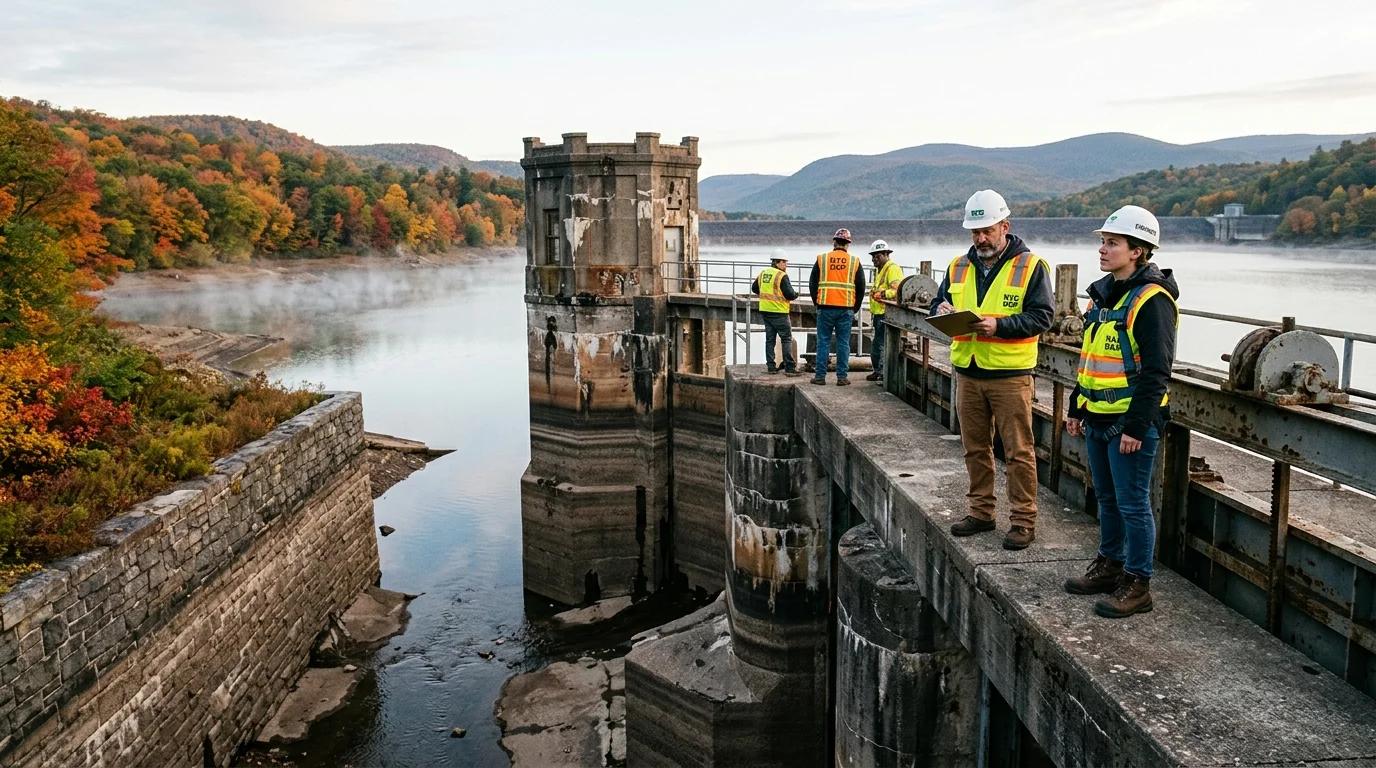
DEP water system specialists and civil engineers inspect outflow infrastructure at an upstate reservoir along the Delaware Aqueduct system. Amid a worsening regional drought, the city suspended a planned $2 billion bypass connection to keep critical mountain water flowing south into New York City's municipal network.
NY DISTRICT NEWSNEW YORK — Confronted with the most severe autumn dry spell in New York City's recorded meteorological history, City Hall and the Department of Environmental Protection (DEP) have executed an emergency operational pivot, halting the landmark $2 billion Delaware Aqueduct Repair Project and reopening the subterranean pipeline ahead of schedule. The decision, announced jointly by Mayor Eric Adams and DEP Commissioner Rohit T. Aggarwala, abruptly suspends a planned multi-month construction shutdown intended to connect a newly constructed bypass tunnel beneath the Hudson River, prioritizing the immediate replenishment of rapidly depleting municipal drinking water reserves.
The Delaware Aqueduct stands as the single most critical artery in New York City's vast regional water supply network. Spanning 85 miles from the Roundout Reservoir in Ulster County down through the Hudson Valley into Hillview Reservoir in Yonkers, the deep rock tunnel normally conveys between 500 million and 600 million gallons of unfiltered water daily—supplying more than half of the metropolitan area's everyday consumption. The aqueduct draws from four colossal Catskill and Delaware watershed impoundments: Pepacton, Cannonsville, Neversink, and Rondout reservoirs. Under normal conditions, these pristine mountain sources provide the natural gravitational pressure and supreme water quality that defines New York's municipal water supply.
However, an unprecedented absence of rainfall stretching from late summer through mid-November pushed upstate reservoir capacities to historic lows, with total watershed capacity plunging well below 60 percent. The persistent dry conditions triggered New York City's first citywide Drought Warning in 22 years and sparked dozens of hazardous brush blazes across regional parklands and Hudson Valley woodlands. While secondary supply sources—most notably the historic Croton River Watershed system and upgraded pumping stations—were activated at maximum capacity during the planned aqueduct shutdown, the lack of seasonal precipitation quickly threatened to overtax localized reserves before winter freeze-up.
'Our municipal water network is world-renowned for its engineering resilience, but no infrastructure project—no matter how monumental—can take precedence over the fundamental obligation to deliver clean, uninterrupted drinking water to 8.3 million New Yorkers,' stated DEP Commissioner Rohit Aggarwala during an operational briefing at the agency's Queens headquarters. 'By halting the bypass connection and reopening the Delaware Aqueduct now, we are allowing gravity-fed water from the Delaware reservoirs to flow freely into our downstream distribution basins, reversing drawdown trajectories and establishing a robust buffer ahead of the winter season.'
The halted construction endeavor, which represents the largest capital repair initiative in the 120-year history of New York City's water supply, was engineered to bypass a pair of chronic geological fractures near Newburgh in Orange County and Wappinger in Dutchess County. Those subterranean fissures have collectively leaked an estimated 35 million gallons of treated drinking water daily into surrounding limestone formations for decades. To resolve the leakage permanently, DEP contractors spent years mining a 2.5-mile, 14-foot-diameter bypass tunnel 600 feet beneath the bed of the Hudson River. The planned autumn 2026 shutdown was designed to pump out the existing tunnel, breach the bedrock bulkheads, and weld the new bypass into the active system.
Because the emergency resumption of flow requires flooding and repressurizing the uncompleted connection shafts, the active construction contract for the bypass tie-in had to be safely demobilized and formally terminated. Senior DEP engineering officials confirmed that a new procurement cycle and environmental review timeline will be established, likely deferring the next viable multi-month shutdown window into the next decade to ensure extensive weather modeling and reservoir replenishment beforehand.
Alongside the aqueduct's reopening, municipal authorities continue enforcing stringent conservation protocols across all municipal entities. Under executive directives issued by City Hall, city agencies have halted fleet vehicle washing, ceased non-critical hydrant flow tests, shut down decorative public fountains, and implemented aggressive acoustic leak detection patrols across underground distribution mains in all five boroughs. As climate volatility creates wider swings between extreme precipitation and protracted droughts, city leaders emphasized that structural water conservation and dual-watershed redundancy must remain permanent cornerstones of New York's municipal planning.