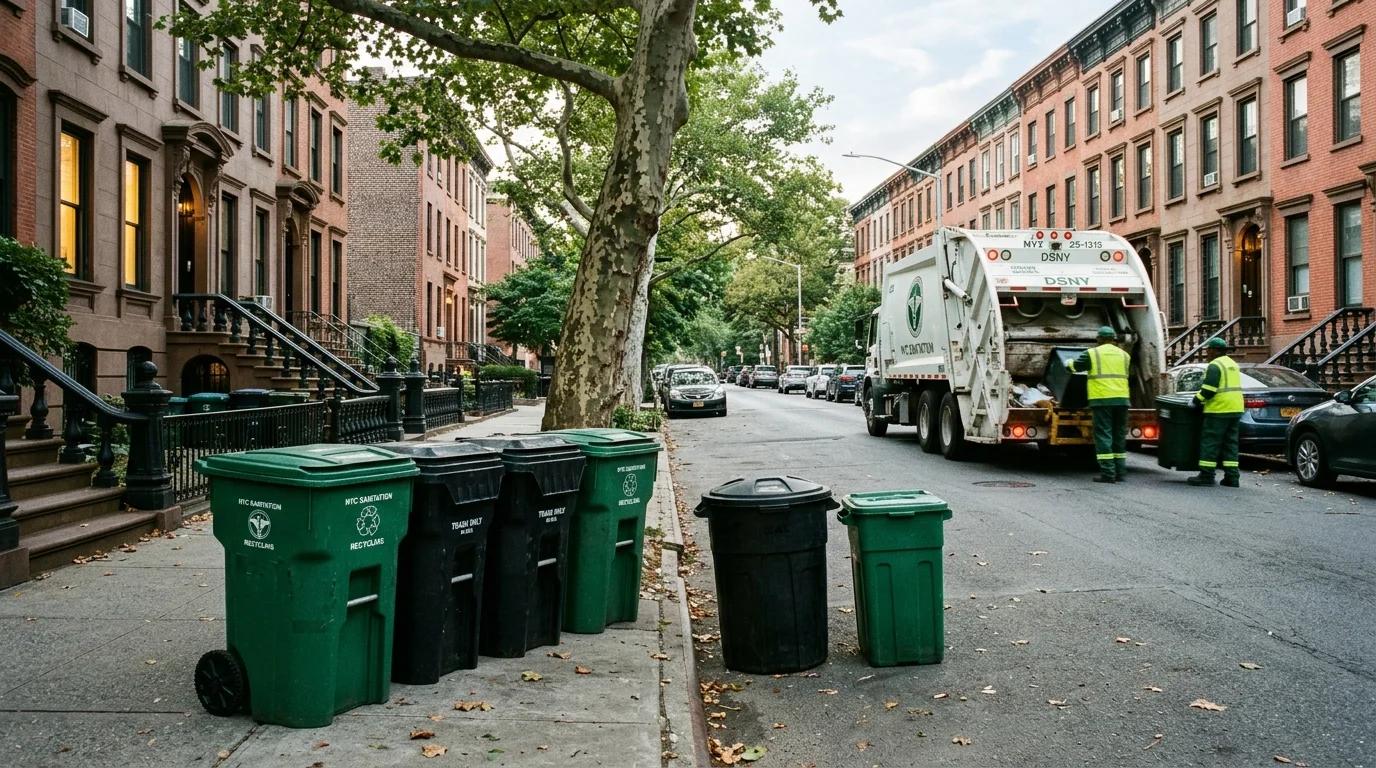
Standardized lidded trash bins aligned along a residential curb in New York City. Under the Department of Sanitation's citywide containerization mandate, 765,000 residential properties with one to nine units must now enclose all household waste in rigid bins with secure lids.
NY DISTRICT NEWSCITY HALL, MANHATTAN — In what municipal administrators describe as the most fundamental transformation of urban waste management in more than fifty years, the New York City Department of Sanitation (DSNY) has officially enacted mandatory residential trash containerization rules across all five boroughs.
Effective immediately, all residential properties containing between one and nine units—encompassing roughly 765,000 properties and roughly 70 percent of all residential buildings in New York City—are legally prohibited from leaving loose black plastic trash bags directly on sidewalks. Instead, all household garbage set out for collection must be stored in secure, rigid receptacles of 55 gallons or less equipped with tight-fitting, latching lids designed to deny rodents access to organic waste.
The citywide rule marks the center-piece of the Adams administration's multifaceted “Trash Revolution,” a long-term capital and regulatory initiative aimed at dismantling New York's historic reputation as the only major global metropolis that deposits millions of pounds of uncontainerized refuse onto pedestrian thoroughfares nightly.
“For decades, New Yorkers have accepted as normal something that no other world-class city tolerates: piling forty-four million pounds of black bags on sidewalks every single day, creating an open buffet for rats,” said Sanitation Commissioner Jessica Tisch. “Today, we officially begin closing that all-you-can-eat buffet for good. By mandating clean, sealed containers across 765,000 residential buildings, we are taking back our streets, cleaning our neighborhoods, and fundamentally elevating the quality of life in every zip code.”
Under the initial regulatory phase, property owners and building managers may utilize any commercially available plastic or metal bin that does not exceed the 55-gallon volume limit, provided it features a secure lid that prevents animal intrusion and windblown debris. However, DSNY has simultaneously rolled out distribution of the custom-engineered “Official NYC Bin,” manufactured with heavy-duty recycled polymers, wheels, and standardized lift bars engineered to interface with mechanical rear-loader tipping arms currently being retrofitted onto the department’s 2,100 collection trucks.
To ensure an orderly operational transition and give property owners adequate time to adjust, DSNY confirmed that sanitation police officers will issue written warning notices rather than monetary penalties through January 2, 2025. Following the expiration of the grace period, administrative summonses will carry escalating fines: $50 for a first offense, $100 for a second offense, and $200 for subsequent infractions adjudicated through the Office of Administrative Trials and Hearings (OATH).
The containerization mandate also coordinates with revised set-out schedule parameters. Properties utilizing compliant bins may place receptacles curbside starting at 6:00 PM on the evening prior to scheduled collection days—providing homeowners and working tenants two extra hours of flexibility compared to the 8:00 PM set-out requirement that previously governed loose bags.
Early data from localized pilot districts in West Harlem and Hamilton Heights demonstrated immediate public health dividends, where rodent complaint calls to 311 plunged by more than 68 percent following 12 months of mandatory containerization. City epidemiologists and pest-control specialists anticipate similar rodent population reductions across high-density residential blocks in Queens, Brooklyn, the Bronx, and Staten Island as the food supply chain for nocturnal pests is severed.
Beyond rodent abatement, the mechanical tipping mechanism reduces the chronic ergonomic strain and musculoskeletal injuries that have historically plagued sanitation workers, who manually hoisted an average of six to eight tons of heavy, puncturable plastic waste per shift.
While community boards and civic associations across Manhattan, Brooklyn, and Queens broadly praised the cleanliness initiative, property owner groups noted lingering logistical challenges in tightly packed neighborhoods with narrow front areaways, basement stairs, or zero side-alley storage. Commissioner Tisch emphasized that DSNY outreach teams are actively collaborating with community district managers and block associations to evaluate supplemental communal containerization models for blocks with unique architectural constraints.