Wednesday, September 2, 2026
TRANSPORTATION• REGIONAL REPORT

MTA Delays Subway CBTC Signal Modernization Across A, C, E, F, and G Lines Into 2028 Amid Software and Data Center Pressures

Agency disclosures and oversight reports confirm that none of the MTA's active Communications-Based Train Control projects will enter full service until late 2027 or 2028, as software calibration hurdles and surging AI data center demand strain transit budgets.
By NY District News Staff•Manhattan, Queens & Brooklyn, New York
November 18, 2026|8 min read
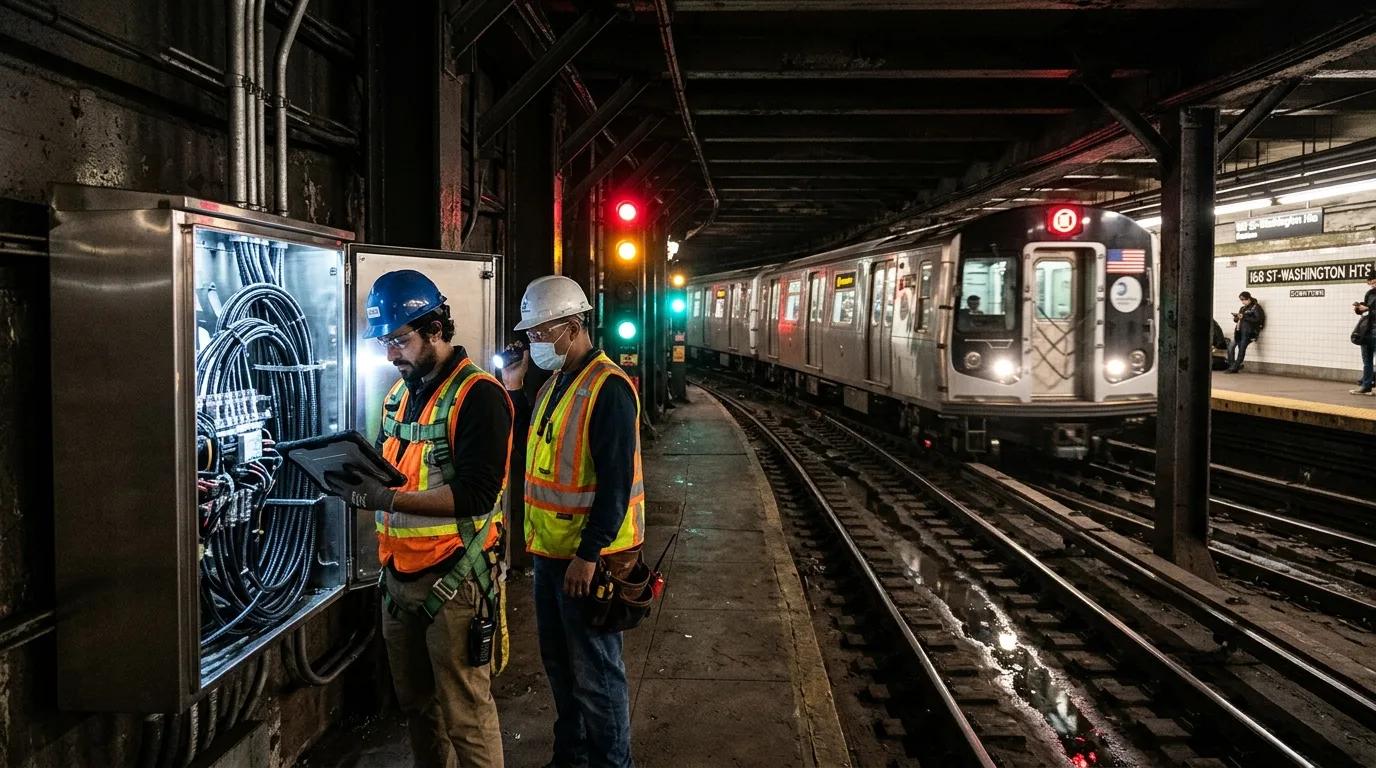
MTA transit signal engineers in high-visibility safety vests and hard hats inspecting trackside cabling inside an open stainless steel Communications-Based Train Control cabinet as a subway train approaches illuminated wayside signals.

Transit signal engineers inspect trackside Communications-Based Train Control (CBTC) cabling and wayside equipment along an underground New York City subway corridor. MTA officials disclosed that software integration complexities, track-geometry discrepancies, and surging hardware competition from AI data centers have pushed active CBTC cutovers into late 2027 and 2028.

NY DISTRICT NEWS

KEY FINDINGS

  • •MTA disclosures confirm all active subway CBTC signal modernization projects across the A, C, E, F, and G lines have fallen months behind schedule, pushing full activations into late 2027 and 2028.
  • •The Fulton Street–Liberty Avenue upgrade (A, C, E) slipped from Q1 2027 to Q4 2027 (with broader extensions reaching toward 2029), while Queens Boulevard East (F) moved from Q2 2027 to Q2 2028 and Crosstown (G, F) slipped to 2028.
  • •MTA Construction and Development President Jamie Torres-Springer noted heavy civil and track work remains on schedule, with delays concentrated in software validation, train compatibility, and physical track-geometry recalibration.
  • •Agency officials warned that rapid expansion of AI and cloud data centers is creating intense market competition for specialized cables and electronic hardware, inflating transit procurement costs.
WHY THIS MATTERS

Communications-Based Train Control is the backbone of MTA reliability upgrades across the five boroughs, enabling more frequent trains and fewer signal failures; software bottlenecks and data-center-driven hardware inflation threaten to stretch capital budgets and prolong aging relay maintenance for millions of daily commuters.

NEW YORK — Millions of daily New York City subway riders waiting for faster, more reliable service across major trunk lines will have to wait longer after the Metropolitan Transportation Authority (MTA) disclosed that every active Communications-Based Train Control (CBTC) signal modernization project in its current capital pipeline has slipped months behind schedule.

According to capital program updates and independent oversight findings reported this week, none of the agency's ongoing computerized signal upgrades—spanning segments of the A, C, E, F, and G lines across Manhattan, Queens, and Brooklyn—are now projected to come fully online before late 2027 or 2028 at the earliest.
The revised schedules affect three cornerstone corridors designed to replace century-old electromechanical fixed-block relays with modern digital train-tracking technology. On the Fulton Street–Liberty Avenue corridor serving A, C, and E riders, initial signal cutovers previously targeted for the first quarter of 2027 have been pushed back to the fourth quarter of 2027, with broader corridor extensions stretching toward 2029.
In Queens, the Queens Boulevard Line East modernization serving the F train has shifted from a second-quarter 2027 launch window to the second quarter of 2028. Meanwhile, the Crosstown CBTC upgrade covering the G and F lines has similarly fallen past its original 2027 phased rollout targets, with neither the northern nor southern sections now expected to enter active digital operation until 2028.
Speaking on the progress of the multi-billion-dollar signal program, MTA Construction and Development President Jamie Torres-Springer emphasized that heavy civil and trackside construction—such as ripping up tunnel infrastructure, installing wayside beacons, and replacing switches—has largely proceeded on schedule without unexpected passenger service disruptions. Instead, agency leaders attributed the schedule slippage primarily to software validation complexities, rolling-stock compatibility testing, and intricate cutover sequencing.
Technical audits along the Eighth Avenue corridor underscored the precision required before switching off legacy relays. Engineers discovered discrepancies between physical track layouts—including subtle curves and vertical grades—and the digital track-geometry data programmed into onboard train computers, requiring time-consuming recalibration to prevent automated braking faults. Those findings have prompted transit planners to abandon high-risk single-day system cutovers in favor of staggered, lower-risk phased activations.
Compounding those engineering hurdles, MTA asset and development officials warned of an emerging macroeconomic pressure threatening future signal budgets: fierce supply chain competition from private artificial intelligence and cloud computing data centers. As technology firms build massive server facilities across North America, they are aggressively procuring specialized fiber-optic cables, industrial switchgear, and high-grade electronic controllers identical to the hardware required for modern rail signaling.
That surging industrial demand has driven up component lead times and unit prices across global procurement markets, forcing transit agencies into a tighter bidding environment just as the MTA prepares to award the next wave of signal contracts. Transit advocates and fiscal watchdogs noted that prolonged reliance on 1930s-era wayside relays not only delays capacity gains—which allow trains to run closer together with real-time headway management—but also increases ongoing maintenance costs on some of the busiest underground lines in the five boroughs.
NY

By NY District News Staff

NY District News reporters cover local government, business, consumer issues, tax fairness, and public accountability across New York.

Share Record:
XFB

Know More About This Story?

If you have documents, records, correspondence, photographs or first-hand information related to this investigation, NY District News wants to hear from you.
CONTINUE READING: MORE FROM NY DISTRICT NEWS

Circular Loop Navigation
THE DISTRICT BRIEF

Serious reporting. Right in your inbox.

Investigations, document dumps, and local accountability stories. No visual noise. Just New York journalism that matters.

Weekly accountability reports. Never shared. Unsubscribe anytime.