Wednesday, September 2, 2026
TRANSPORTATION• REGIONAL REPORT

Governor Hochul and MTA Unveil Revised 9 Dollar Manhattan Congestion Pricing Plan to Secure 15B Transit Capital Program

State leaders lower daytime vehicle entry charge from $15 to $9 starting January 2025, directing billions toward subway signal upgrades, accessibility elevators, and regional commuter rail improvements.
By NY District News Staff•Manhattan, New York
November 11, 2026|8 min read
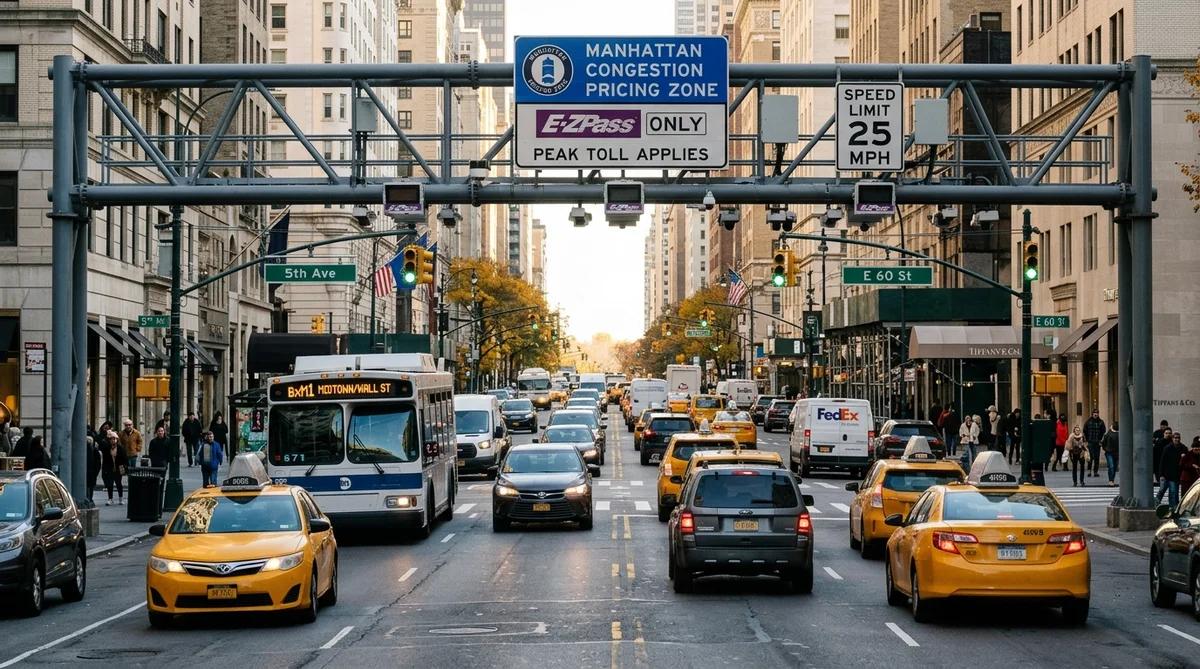
Electronic tolling gantry with sensors and cameras spanning a multi-lane Manhattan avenue as vehicles and MTA buses travel into the Midtown Central Business District.

An overhead congestion pricing detection gantry on a Manhattan avenue. Under the state's revised Central Business District Tolling Program, passenger vehicles entering south of 60th Street will pay a $9 daytime toll to fund $15 billion in MTA capital infrastructure.

NY DISTRICT NEWS

KEY FINDINGS

  • •Governor Hochul and MTA leadership announce restructured congestion pricing with base daytime passenger car tolls reduced from $15 to $9.
  • •Tolls will apply to vehicles entering Manhattan south of 60th Street, with overnight discounts of 75 percent and crossing credits for tolled tunnels.
  • •Revenue unfreezes $15 billion in bonded financing for the MTA's 2020-2024 and 2025-2029 Capital Plans, protecting vital signal modernization and station accessibility.
  • •Projected to reduce vehicular traffic volume in the Manhattan Central Business District by 10 to 12 percent, increasing cross-town bus speeds.
  • •The MTA Board prepares for immediate formal vote to submit updated environmental documentation to the Federal Highway Administration ahead of January launch.
WHY THIS MATTERS

Manhattan's Central Business District suffers from some of the slowest vehicular travel times in the nation, crippling bus schedules and emergency response. Slashing the toll to $9 while preserving the $15 billion capital funding stream delivers long-delayed capital investments in subway reliability, modern communications-based train control (CBTC), and elevator accessibility across transit deserts in Queens, Brooklyn, the Bronx, and Manhattan.

MANHATTAN — In a decisive policy pivot designed to unfreeze billions of dollars in stalled transit infrastructure investments while addressing intense suburban affordability concerns, Governor Kathy Hochul and Metropolitan Transportation Authority (MTA) leadership have formally unveiled a revised Manhattan Central Business District Tolling Program featuring a restructured $9 peak vehicle toll.

The newly calibrated framework represents a 40 percent reduction from the originally approved $15 daytime rate. Beginning in January 2025, passenger vehicles entering Manhattan south of 60th Street will pay $9 once per day during peak hours when utilizing a valid E-ZPass. Small trucks will pay $14.40, large multi-axle freight trucks will pay $21.60, and overnight motorists entering between 9:00 PM and 5:00 AM will receive a 75 percent discount, paying just $2.25.
Crucially for the region's transit ridership, the restructured toll structure provides the dedicated revenue baseline necessary to support $15 billion in municipal bonding capacity. That capital stack forms the backbone of the MTA's 2020–2024 Capital Program, which ground to a sudden halt in June when the governor paused the initiative weeks before its scheduled implementation.
“By cutting the toll by forty percent, we are saving everyday commuters thousands of dollars a year while still achieving the essential goals of this landmark program: un-jamming our streets, cleaning our air, and delivering the fifteen billion dollars in capital funding that the MTA needs to run reliably,” Governor Hochul said during the formal announcement at the MTA’s 2 Broadway headquarters.
The release of capital dollars immediately reactivates several high-priority modernization initiatives that had been frozen across the transit network. Chief among them is the deployment of modern Communications-Based Train Control (CBTC) signaling along the Fulton Line in Brooklyn and the Sixth Avenue Line in Manhattan, which will allow trains to run closer together and substantially increase rush-hour capacity.
Additionally, the revenue unlocks funding for dozens of Americans with Disabilities Act (ADA) accessibility projects across the subway system—guaranteeing the installation of new elevators and boarding platforms at 23 transit hubs that currently lack wheelchair access—and finances hundreds of new zero-emission battery-electric transit buses and modernized railcars.
Traffic modeling conducted by the MTA indicates that even at the lower $9 toll point, vehicular volume entering the Manhattan congestion relief zone is projected to decrease by approximately 10 to 12 percent. That reduction is estimated to boost average traffic speeds within Midtown by up to 15 percent, delivering immediate reliability improvements for hundreds of thousands of daily commuters riding local and express MTA buses.
The plan also retains crossing credits for drivers entering Manhattan through the Lincoln, Holland, Queens-Midtown, and Hugh L. Carey tunnels, preventing double-tolling during peak hours. Low-income drivers who earn under $50,000 annually can qualify for a 50 percent discount on all daytime trips after their tenth trip in a single calendar month.
Despite broad praise from urban planning groups, environmental coalitions, and transit advocacy organizations like the Riders Alliance and Transportation Alternatives, the policy resurrection faces continued political pushback. Lawmakers from suburban Rockland, Nassau, and Suffolk counties, alongside New Jersey state officials who have challenged the toll in federal court, reiterated objections regarding commuter pocketbook impacts.
The MTA Board is scheduled to convene an emergency public session to formally approve the updated toll schedule and complete updated environmental submissions to the Federal Highway Administration (FHWA), clearing the final regulatory hurdles for system go-live in early January.
NY

By NY District News Staff

NY District News reporters cover local government, business, consumer issues, tax fairness, and public accountability across New York.

Share Record:
XFB

Know More About This Story?

If you have documents, records, correspondence, photographs or first-hand information related to this investigation, NY District News wants to hear from you.
CONTINUE READING: MORE FROM NY DISTRICT NEWS

Circular Loop Navigation
THE DISTRICT BRIEF

Serious reporting. Right in your inbox.

Investigations, document dumps, and local accountability stories. No visual noise. Just New York journalism that matters.

Weekly accountability reports. Never shared. Unsubscribe anytime.