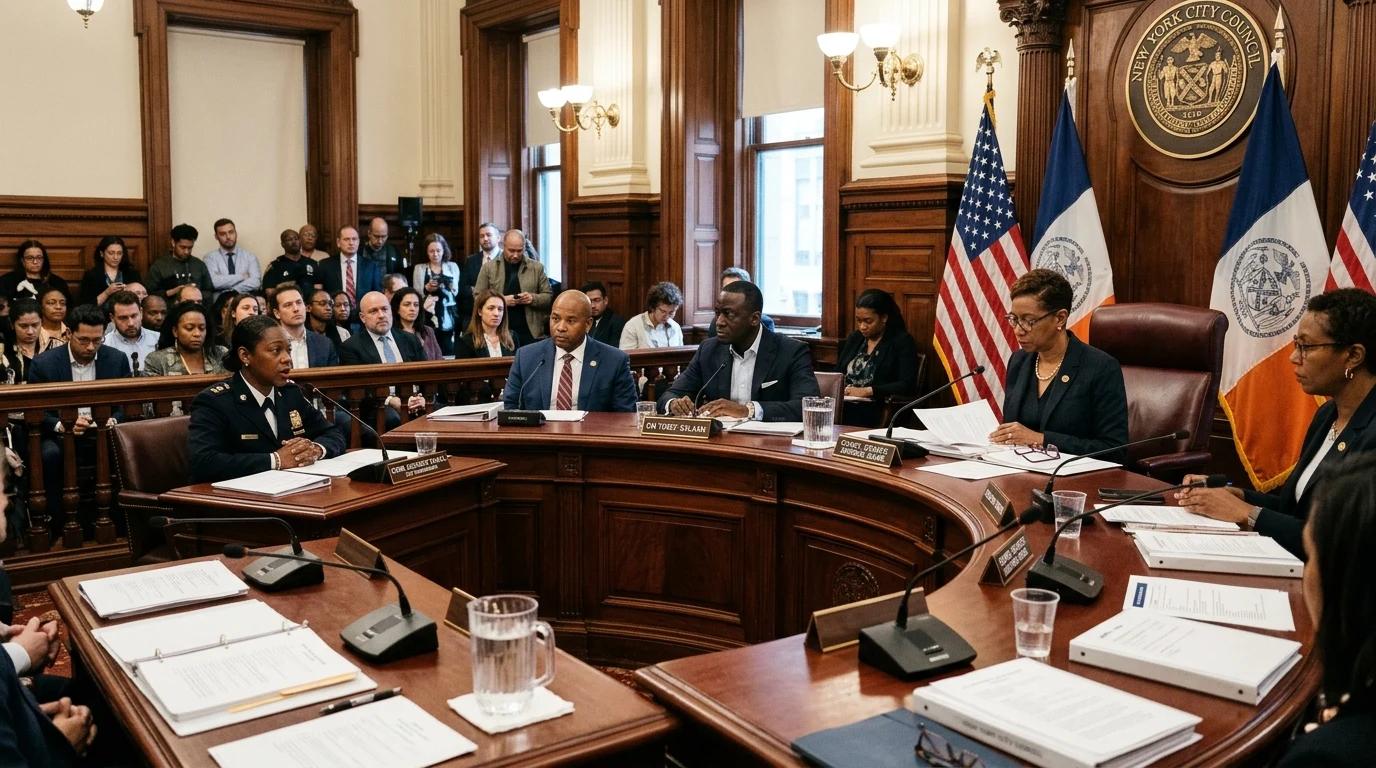
The City Council chamber at City Hall in Lower Manhattan. Speaker Julie Menin and committee chairs have scheduled a high-priority joint oversight hearing on November 20 to mandate certified lithium-ion battery storage standards and expand FDNY enforcement protocols.
NY DISTRICT NEWSCITY HALL, MANHATTAN — Facing a relentless surge in catastrophic structural fires linked to micromobility power cells, leadership of the New York City Council has convened an emergency joint oversight hearing and legislative session scheduled for November 20, 2026, aimed at overhauling residential fire safety codes and curbing unregulated lithium-ion battery commerce across the five boroughs.
The high-stakes hearing will unite the Committee on Fire and Emergency Management, chaired by Council Member Joann Ariola, and the Committee on Housing and Buildings, chaired by Council Member Pierina Sanchez, alongside City Council Speaker Julie Menin. The legislative initiative responds directly to alarming municipal data released by the Fire Department of New York (FDNY), confirming that lithium-ion battery fires have escalated sharply throughout 2026.
According to official department tallies, the FDNY has responded to 406 lithium-ion battery fires across the city through early November 2026—a stark increase compared to 241 incidents recorded during the identical calendar timeframe in 2025. The fires have claimed 10 lives this year and resulted in scores of critical injuries to civilians and first responders, highlighted by fatal multi-alarm residential blazes in Sunset Park, Brooklyn, and the South Bronx that displaced dozens of immigrant working-class families.
“We cannot normalize a reality where working New Yorkers go to sleep fearing that an uncertified micromobility battery in a neighbor’s hallway or ground-floor repair shop will ignite into an inescapable fireball,” Speaker Julie Menin said in a statement outlining the committee agenda. “The Council is moving aggressively to close regulatory enforcement gaps, inspect illegal aftermarket battery rebuilders, and establish safe, city-subsidized public charging infrastructure that protects delivery workers and residential tenants alike.”
Central to the upcoming oversight hearing is an evaluation of Local Law 39 of 2023, which prohibited the sale, lease, or rental of uncertified electric bicycles, mopeds, and lithium-ion batteries that fail to meet recognized safety standards such as UL 2849 and UL 2272. While the NYC Department of Consumer and Worker Protection (DCWP) has conducted hundreds of storefront stings and seized non-compliant equipment, council members point out that illicit, uncertified battery packs continue to flood local markets through gray-market online retailers, unpermitted repair workshops, and underground swaps.
Beyond commercial retail enforcement, the council’s draft legislative package targets residential landlord obligations and tenant safety protocols. Proposed measures under review would require residential property owners with more than 20 units to provide outdoor, fire-rated charging lockers equipped with specialized aerosol thermal-runaway suppression systems, or designated ventilated ground-floor charging zones, prohibiting the overnight charging of multiple commercial batteries in enclosed residential hallways or stairwells.
The hearings will also confront an emerging municipal operational hazard: a sharp rise in battery-related fires aboard New York City Department of Sanitation (DSNY) collection trucks. Sanitation officials report that improperly discarded lithium-ion cells in household trash compactors have ignited repeated hopper blazes, forcing collection crews to conduct emergency trash dumps onto public streets to save city vehicles from burning.
Advocates representing the city's estimated 65,000 app-based food delivery workers—deliveristas who rely on e-bikes for their daily livelihoods—emphasize that punitive enforcement alone will fail without accessible, affordable safe infrastructure. Delivery worker organizations are calling on the council and city agencies to dramatically expand the city’s pilot battery-swap networks and subsidized trade-in programs, allowing couriers to surrender dangerous, second-hand batteries in exchange for certified, fire-resistant models at low or zero cost.
“Deliveristas are the economic backbone of this city's restaurant economy, but low pay and grueling delivery quotas force workers to purchase whatever refurbished battery they can afford,” noted Ligia Guallpa, executive director of the Worker's Justice Project. “If the city wants to eliminate death and destruction from battery fires, it must provide public swap stations on every major commercial corridor and ensure delivery workers have direct access to certified batteries.”
The joint committee hearing on November 20 will take public testimony from FDNY leadership, the Department of Buildings, DCWP, battery safety scientists, tenant associations, and micromobility industry representatives, with legislative votes on the omnibus fire prevention package expected before the close of the calendar year.