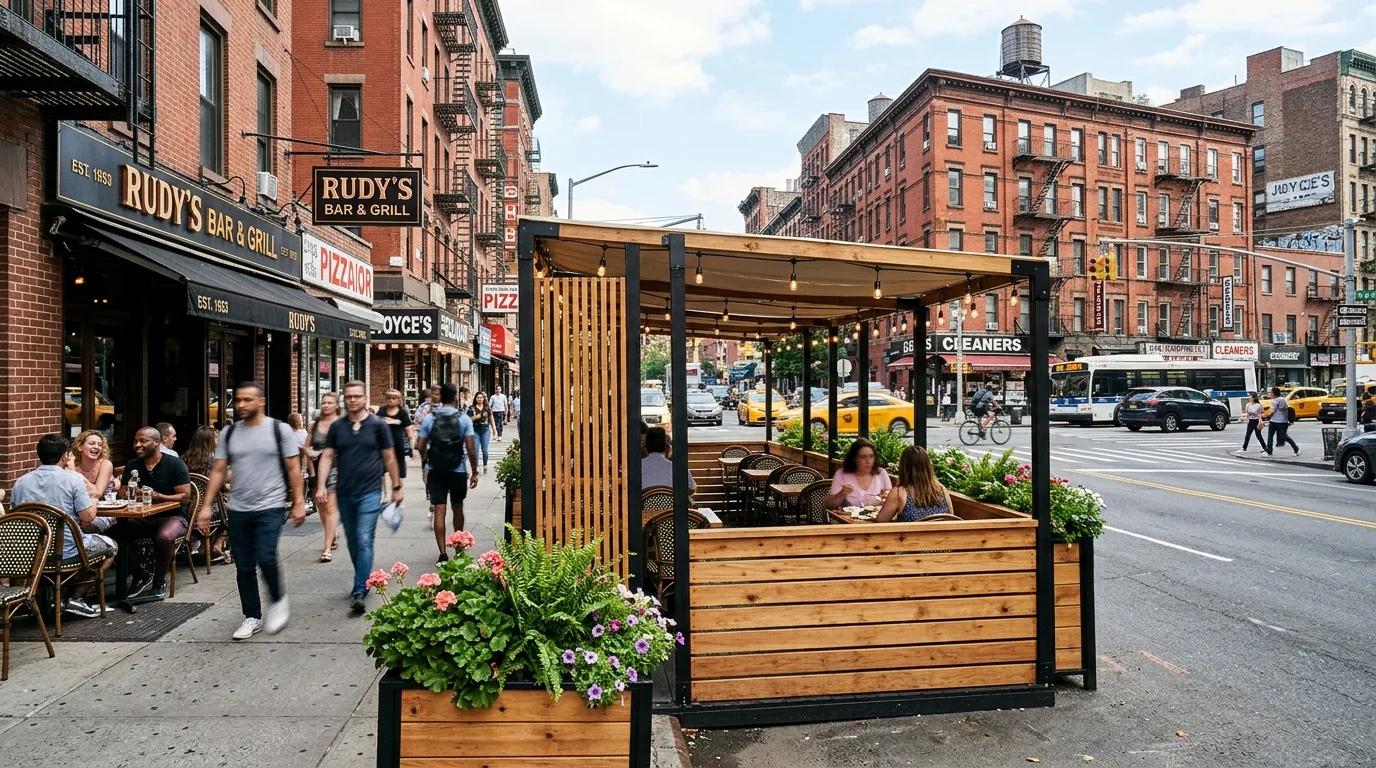
A curbside roadway dining setup outside a New York City restaurant. An audit by Comptroller Mark Levine revealed that participating restaurants face average waits exceeding 19 months to secure permanent Dining Out NYC licenses from the Department of Transportation.
NY DISTRICT NEWSNEW YORK — When New York City codified 'Dining Out NYC' into law, city officials promised a streamlined, predictable successor to the emergency pandemic-era open restaurants program that saved thousands of hospitality jobs. Instead, according to an exhaustive municipal audit published by New York City Comptroller Mark Levine, the permanent program has devolved into an agonizing bureaucratic gauntlet that forces neighborhood restaurants to wait more than a year and a half for basic operating permits.
The Comptroller’s audit examined 4,911 outdoor dining applications submitted to the New York City Department of Transportation (DOT) between the program's official rollout in March 2024 and the mid-2026 data evaluation cutoff. The investigation discovered that among the establishments that successfully obtained outdoor dining licenses, more than 50 percent waited over 19 months from initial application submission to final license issuance—more than double the agency's publicized eight-month target timeline.
Even more alarming for the city's culinary economy, only 28.6 percent of applicants—a mere 1,405 establishments across the five boroughs—had secured active outdoor dining licenses by the conclusion of the audit period. More than 2,100 applications remained languishing in administrative backlog, leaving thousands of restaurateurs operating in regulatory limbo or forfeiting lucrative outdoor seating revenue altogether.
“Outdoor dining fundamentally revived our street life and demonstrated how public curb space can serve community vitality and neighborhood economies,” Comptroller Levine stated upon releasing the findings. “Yet rather than establishing an accessible, transparent system for mom-and-pop eateries, the city built an administrative obstacle course where small business owners are forced to hire private expediters, commission complex architectural blueprints, and wait nearly two years just to place tables outside.”
A central vulnerability uncovered by the Comptroller's investigators is the DOT’s failure to establish a centralized 'system-of-record' to track where applications stall in the review pipeline. Because the application process requires clearances across multiple municipal bodies—including local Community Boards, the NYC Department of City Planning, the Landmarks Preservation Commission, the Fire Department, and the Department of Environmental Protection—the absence of inter-agency milestone tracking prevented administrators from identifying bottlenecks or calculating how long files sat dormant on agency desks versus awaiting applicant revisions.
The financial stakes for participating restaurants have been particularly severe for roadway setups. Under initial statutory guidelines, roadway dining setups were restricted to an eight-month seasonal operating window running from April through November, requiring complete seasonal deconstruction during winter months. As a consequence of 19-month processing queues, dozens of restaurateurs lost two entire outdoor operating seasons before receiving formal municipal authorization.
While recent legislative interventions, including Local Law 135 of 2026, have moved to legalize year-round roadway dining setups, the Comptroller warned that without fundamental procedural streamlining, expanded seasonal eligibility will only compound the administrative pileup. Furthermore, the report cited burdensome technical requirements, such as requiring certified architectural schematics detailing curb water drainage flow rates and utility sub-surface clearances that far exceed the technical capacity or budget of immigrant-owned and family-operated eateries.
In response to the audit, the Department of Transportation defended its stewardship of the public right-of-way, noting that processing velocity accelerated significantly throughout 2026 as automated workflows and additional staffing were deployed. Agency officials emphasized that rigorous review is necessary to guarantee Americans with Disabilities Act (ADA) sidewalk clearance, emergency vehicle access, sightline safety at intersections, and rat-mitigation standards.
Nonetheless, hospitality advocates and restaurant associations, including the NYC Hospitality Alliance, echoed the Comptroller's recommendations, calling on the City Council and the Mayor's Office of Small Business Services to create an ombudsperson unit and establish standardized pre-approved modular shed blueprints that bypass costly individual architectural reviews.