Wednesday, September 2, 2026
CONSUMER AFFAIRS• REGIONAL REPORT

Central Park Horse Carriages Face 2028 Prohibition Under Romanch's Law as Lawmakers Mandate Workforce Transition Fund

City Council enacts Intro 943 to phase out equine tourism operations over two years, allocating worker retraining grants through Consumer and Worker Protection while transit union mounts federal legal challenge.
By NY District News Staff•Manhattan, New York
November 3, 2026|6 min read
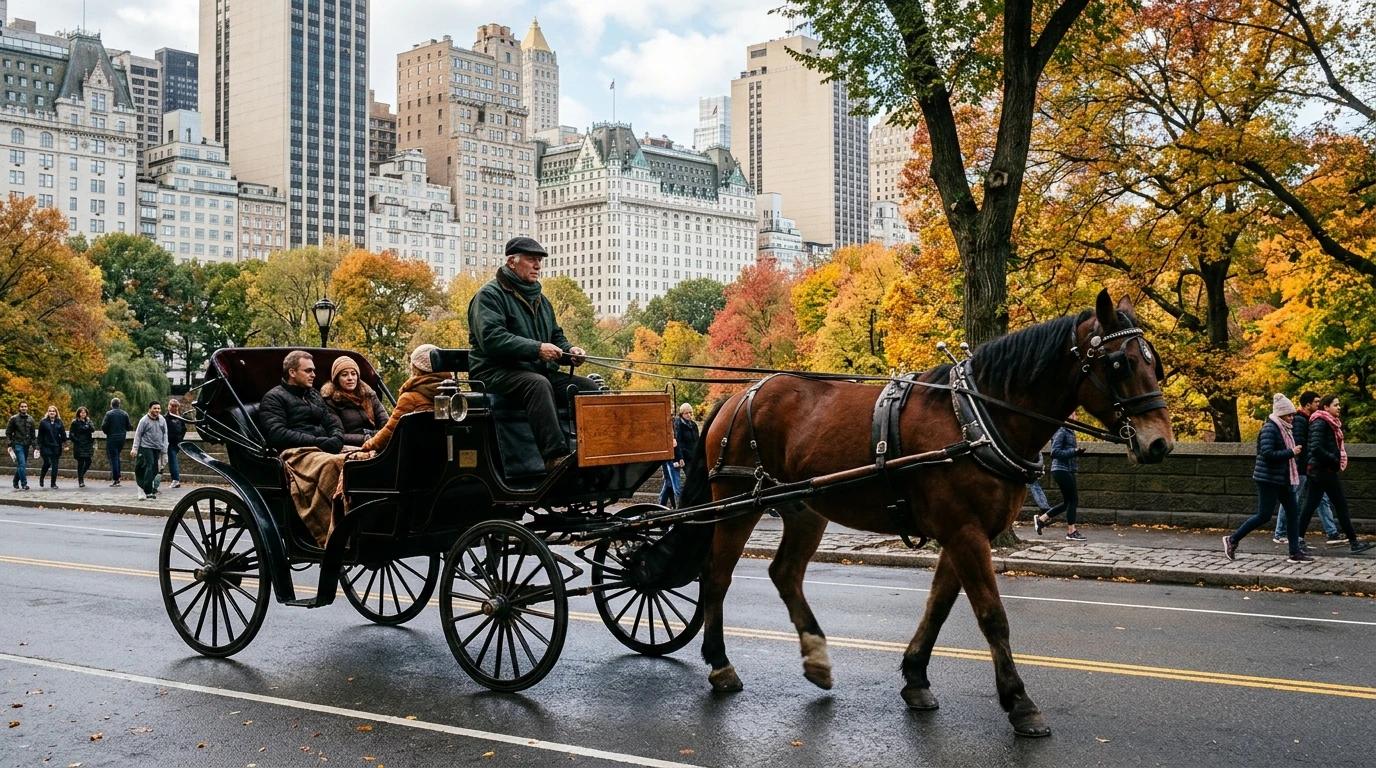
Horse-drawn carriage positioned near Central Park South in Manhattan.

A horse-drawn carriage operating along Central Park South, where the New York City Council has mandated a complete industry phaseout by June 2028 under Romanch's Law.

NY DISTRICT NEWS

KEY FINDINGS

  • •Romanch's Law (Intro 943) imposes a complete ban on Central Park horse-drawn carriages effective June 1, 2028.
  • •The Department of Consumer and Worker Protection immediately freezes new operator licenses and carriage horse medallions.
  • •A dedicated municipal workforce transition fund will provide job retraining and electric vehicle operating credits for licensed drivers.
  • •TWU Local 100 is mounting a federal constitutional lawsuit challenging the ban as an unlawful regulatory taking.
WHY THIS MATTERS

The resolution of the decades-long Central Park carriage debate balances modern animal welfare standards and street safety against the livelihoods of veteran blue-collar operators, establishing a landmark precedent for municipal licensing reform.

NEW YORK — In one of the most contentious municipal regulatory decisions in modern New York history, the City Council has officially enacted Romanch's Law (Intro 943), setting a definitive timetable to retire and ban the historic horse-drawn carriage industry in Central Park by June 1, 2028.

The 40–7 veto-proof council vote culminates more than two decades of intense lobbying from animal welfare organizations and civic advocates, who have argued that dense Midtown traffic, rising summer heat indices, and tight asphalt carriage corridors pose insurmountable risks to equine welfare. The legislative momentum accelerated following the tragic death in June 2026 of 18-year-old tourist Romanch Mahajan, who died when a spooked carriage horse collided with roadside fixtures along 59th Street.
Under the statutory terms of Intro 943, the Department of Consumer and Worker Protection (DCWP) will immediately freeze the issuance of any new carriage horse medallions and operator licenses. Existing permit holders may continue operating through the spring of 2028 under tightened veterinary oversight, after which all commercial carriage operations on city streets and within park boundaries become unlawful.
A centerpiece of the legislation addresses the economic fallout for roughly 160 drivers, stablehands, and carriage owners. The bill mandates that the city establish a multi-million-dollar workforce transition and severance fund administered through DCWP and the Department of Small Business Services, providing priority placement in electric sightseeing vehicles, job retraining grants, and financial buyouts for surrendered medallions.
The statute also enacts strict animal disposition guarantees: carriage horses cannot be sold into slaughter pipelines or transferred to out-of-state commercial haulers, requiring verified transfers to accredited equine sanctuaries and retirement farms vetted by the city.
Despite the decisive council majority, the transition faces an immediate legal counteroffensive. Transport Workers Union (TWU) Local 100, representing carriage drivers, announced it is filing an emergency federal civil rights and constitutional challenge in U.S. District Court for the Southern District of New York, alleging that the regulatory ban constitutes an unconstitutional taking of private property and unlawfully targets immigrant-heavy small business owners.
Civic organizations across Manhattan and citywide transit monitors noted that the phaseout signals a broader transformation of New York's park perimeters, shifting public space priorities from 19th-century traditions toward modern, pedestrian-first urban greenways.
NY

By NY District News Staff

NY District News reporters cover local government, business, consumer issues, tax fairness, and public accountability across New York.

Share Record:
XFB

Know More About This Story?

If you have documents, records, correspondence, photographs or first-hand information related to this investigation, NY District News wants to hear from you.
CONTINUE READING: MORE FROM NY DISTRICT NEWS

Circular Loop Navigation
THE DISTRICT BRIEF

Serious reporting. Right in your inbox.

Investigations, document dumps, and local accountability stories. No visual noise. Just New York journalism that matters.

Weekly accountability reports. Never shared. Unsubscribe anytime.