Wednesday, September 2, 2026
ENVIRONMENT• REGIONAL REPORT

NYC Environmental Protection Launches WISER Rulemaking to Slash Diesel Truck Emissions at Outer-Borough Freight Warehouses

Department of Environmental Protection issues Positive Declaration and schedules public scoping for landmark clean air program, targeting logistics hubs across Queens, the Bronx, and Staten Island to curb asthma-inducing mobile source pollution.
By NY District News Staff•New York, New York
November 3, 2026|7 min read
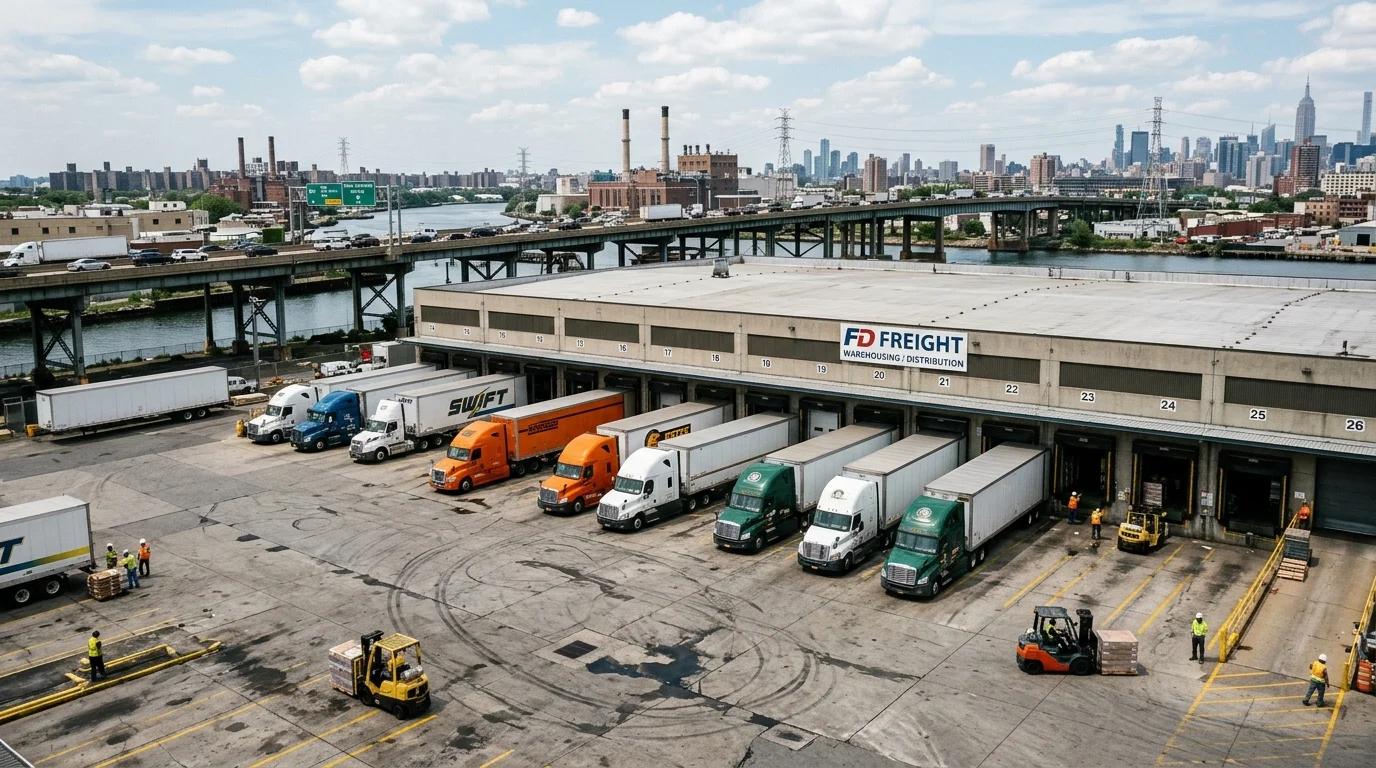
Freight logistics distribution warehouse with commercial semi-trucks docked at loading bays in an outer borough of New York City.

A commercial logistics distribution center in New York City, where the Department of Environmental Protection is advancing the WISER program to regulate indirect mobile emissions from heavy-duty freight truck traffic.

NY DISTRICT NEWS

KEY FINDINGS

  • •NYC DEP issued a Notice of Positive Declaration initiating the Draft Environmental Impact Statement for the Warehouse Indirect Source Emissions Reduction (WISER) program.
  • •A virtual public scoping meeting is scheduled for November 17, 2026, opening public input on warehouse emission thresholds.
  • •The indirect source rules target major e-commerce and logistics distribution centers exceeding 50,000 square feet across the Bronx, Queens, and Staten Island.
  • •Warehouse operators must track heavy truck trips and offset emissions through on-site EV chargers, electric fleet usage, rooftop solar, or mitigation fees.
  • •Advocates point to disproportionate pediatric asthma rates in the South Bronx and Maspeth as primary impetuses for stringent municipal oversight.
WHY THIS MATTERS

By holding warehouse owners accountable for the thousands of diesel trucks servicing their facilities, the WISER program establishes a direct municipal regulatory tool to combat respiratory health crises in outer-borough environmental justice communities.

NEW YORK — In the city's most aggressive regulatory intervention to date against commercial diesel pollution, the New York City Department of Environmental Protection (DEP) has formally initiated environmental review for the Warehouse Indirect Source Emissions Reduction (WISER) program, targeting the sprawling logistics and e-commerce fulfillment hubs that line outer-borough transit arteries.

The agency published a formal Notice of Positive Declaration alongside a Draft Scoping Document under the City Environmental Quality Review (CEQR) framework, scheduling a virtual public scoping hearing for November 17, 2026. The scoping process marks the official commencement of a comprehensive Draft Environmental Impact Statement (EIS) required to codify binding indirect source emission rules into the Rules of the City of New York.
Unlike traditional stationary source regulations that govern factory smokestacks or power plant turbines, the WISER rules address 'indirect sources'—facilities that do not necessarily emit high volumes of pollutants from their buildings, but attract or generate thousands of heavy-duty, diesel-powered truck trips daily.
Under the regulatory framework outlined in the scoping documents, the mandate will apply to all commercial warehousing, parcel delivery, logistics fulfillment, and freight storage facilities citywide that encompass at least 50,000 gross square feet or operate dedicated multi-bay loading docks generating intensive truck activity. Major industrial corridors heavily scrutinized include the South Bronx industrial waterfront (Hunts Point and Port Morris), Western Queens distribution centers (Maspeth, Long Island City, and the JFK cargo perimeter), and Staten Island's Bloomfield logistics park.
For decades, these outer-borough communities have borne a severely disproportionate health burden from commercial goods movement. Neighborhoods like Mott Haven and Hunts Point in the Bronx—frequently dubbed 'Asthma Alley'—register pediatric asthma emergency room visitation rates up to triple the state average, driven primarily by fine particulate matter (PM2.5) and nitrogen dioxide (NO2) concentrated along truck freight routes.
Under the proposed point-based compliance architecture modeled in part after Southern California's pioneering Rule 2305, warehouse facility operators will be required to calculate an annual truck-trip burden score. Operators must acquire compliance points through a menu of on-site clean air investments, such as installing Level 2 and DC fast-charging depots for heavy-duty electric commercial vehicles, requiring contract carriers to deploy zero-emission delivery fleets, installing rooftop commercial solar photovoltaic arrays, or paying an in-lieu municipal mitigation fee dedicated to local community clean air projects.
Freight logistics industry representatives and e-commerce trade coalitions, while expressing support for long-term decarbonization goals, raised critical concerns regarding implementation timelines, capital expenditure requirements, and electric grid capacity. Industry representatives noted that installing high-voltage megawatts of charging infrastructure for heavy truck fleets often requires multi-year utility interconnection queues with Consolidated Edison.
Environmental justice organizations and clean transit coalitions commended DEP's action as a vital enforcement tool to protect residential perimeters from freight saturation. Community advocates emphasized that the rapid expansion of last-mile delivery warehouses over the past half-decade had outpaced existing zoning tools, necessitating direct environmental performance standards.
Following the November 17 public scoping session, DEP will accept written public comments before publishing a final scope of work, paving the way for the formal Draft EIS and public hearings ahead of final regulatory promulgation in 2027.
NY

By NY District News Staff

NY District News reporters cover local government, business, consumer issues, tax fairness, and public accountability across New York.

Share Record:
XFB

Know More About This Story?

If you have documents, records, correspondence, photographs or first-hand information related to this investigation, NY District News wants to hear from you.


CONTINUE READING: MORE FROM NY DISTRICT NEWS

Circular Loop Navigation
THE DISTRICT BRIEF

Serious reporting. Right in your inbox.

Investigations, document dumps, and local accountability stories. No visual noise. Just New York journalism that matters.

Weekly accountability reports. Never shared. Unsubscribe anytime.